Great Flour
Laucke Flour Mills select the best grains to process through our roller and stone grinding mills to create the great flour appreciated by our customers. Of all the cereals milled for flour, wheat is the best known grain and most consumed type of flour in Australia due to the unique properties of wheat gluten. Laucke utilise a variety of grains including wheat, rye, spelt and triticale.
The various processes employed during the conversion of grain to flour have become many and varied, and keep evolving. Grain has 3 major components, being the Bran which is the protective outer layers of the grain, the Germ which is the embryo of the next generation of the plant, and the Endosperm which is the food storage component that provides the nutrients and energy to provide the sustenance required for the initial establishment of the plant. The endosperm is a crystalline matrix of complex carbohydrate and protein which, in fine particle form, is commonly known as white flour.
To produce the highest quality flour, the aim of the miller is to identify and source the most suitable grain to create a grist for the mill, to properly prepare the grist for milling, and to then grind and separate as much good quality flour as possible from the grain without damaging the components of the grain.
The great flours we produce have the flavour, taste, and texture profiles to enable bakers to consistently produce great products.
The following content first shows the milling processes we employ in general, and then describes the individual grinding and sifting methods we apply to produce various Flours and meals from wheat using either Roller Mills or Stone Mills or a carefully considered proportion of both.
WHEAT MILLING
-
GRAIN SOURCING
Grain is a Variety-based crop that is seasonally grown and harvested annually, and which varies in quality according to the genetically conferred attributes of the grain Variety, the intrinsic nature of the soil and region, and the seasonal effects on the growing environment. Each parcel of grain is unique, and has the potential to confer unique characteristics to the Flour created from it.
All our farmer partners employ farming methods that seek to preserve and improve the integrity and fertility of their soils and the local environment for themselves and their future generations, where such practices are commonly referred to with Organic, Sustainable and Regenerative Agriculture Systems. This close partnership and our quality control systems allow us to be able to trace the content of every batch of flour back to the grain grown and sourced from every farm.
-
GRISTING
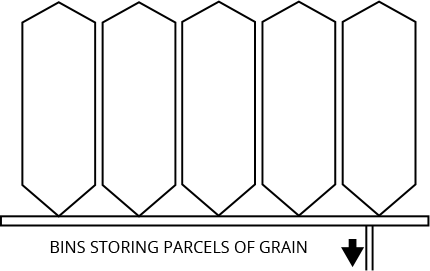
Each parcel of grain is unique, and has the potential to confer unique characteristics to the flour created from it. For example, grain that is useful for making a shortbread biscuit will be totally unsuitable for making a croissant.
When planning and creating a Grist (mix) of various grains for input to the Mill, it is very important for Millers to know their grain and work closely with their trusted farmer partners, in choosing the most appropriate variety and type for the flour required.
-
GRAIN CLEANING & CONDITIONING
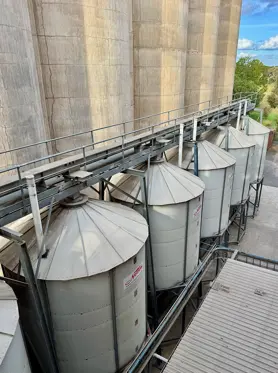
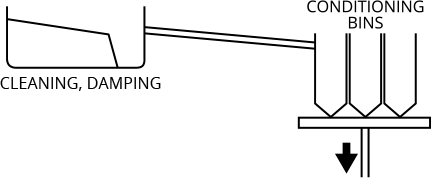
Farmers clean the grain as they reap it. Millers clean the grain as they receive it and again clean the grain before they mill it. Mill Cleaning is an intensive and multi-step process, intended to remove any foreign or unsuitable seeds, un-millable material; and any biological and physical contaminants.
Water is utilised to progressively Condition and Temper the grain in multiple steps over several days. With grain Conditioning, we seek to make the Branny outer layers of the grain more flexible and readily separable from the endosperm. With grain Tempering, we seek to modify the crystalline matrix that binds the endosperm such that, when ground, the complex carbohydrate provides the intended rate of water absorption and rate of fermentation when utilised as flour within a dough.
-
COARSE GRINDING
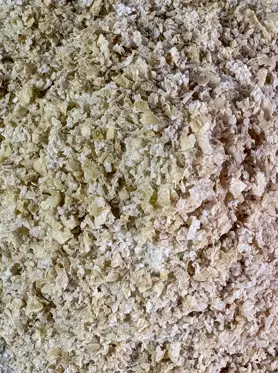
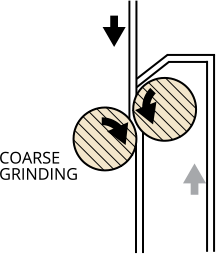
So as to be able to remove the bran from within the crease of the wheat grain, and to be able to separate the bran as flakes, cleaned and conditioned Grain is progressively passed through a series of coarse grinding machines with different grinding gaps, where the grain is firstly broken open. Then progressively over subsequent grinding passages, adhering endosperm is scraped off the flakes of bran, and the largest lumps of endosperm are reduced to more manageable particle sizes (semolina).
-
SIFTING & PURIFYING
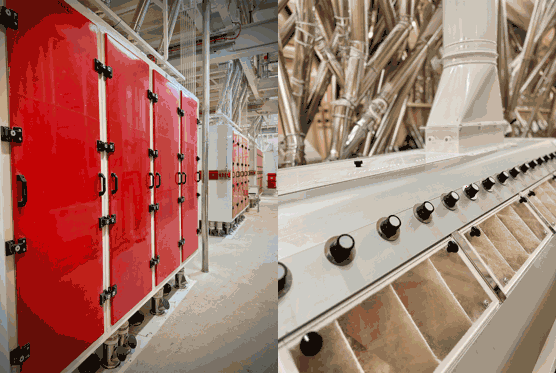
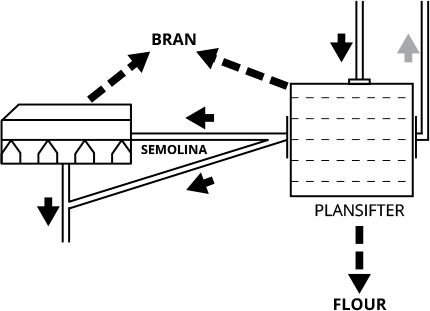
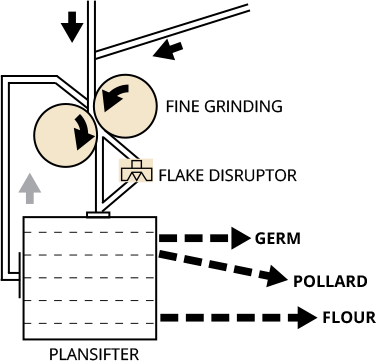
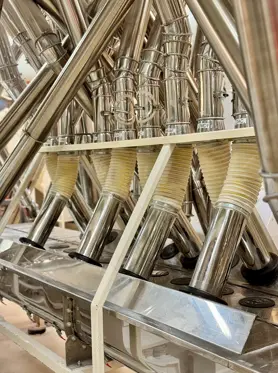
Grain is progressively Coarsely and Finely ground, and each outcome is then Sifted; and this creates multiple streams containing various proportions of the various components of the grain. Careful sifting and sorting of ground grain allows the various components of the ground grain to be separated by particle size, shape, and density. Our Plansifters have multiple sieves for every stream and sort all ground product, separating semolina, flour, bran and wheat germ. Our Purifiers utilise air flotation to sift, sort and clean semolinas of similar particle size by shape and density, where purified semolina can then be sent for Fine grinding.
More streams are created for further grinding, where, after every grinding passage, and consequent to sifting, some “flour” is released and other components are streamed for further grinding and sifting.
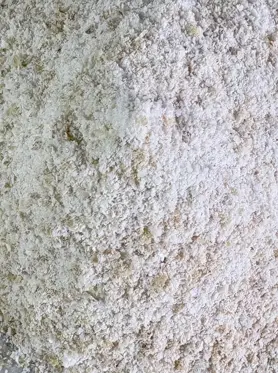
Purified semolina, when ground and sifted to a fine-enough particle size which will absorb water as appropriate and be able to create the intended dough or batter, is called “flour”.
-
FINE GRINDING
Purified semolina is progressively finely ground and Sifted to reduce particle size. With each grinding and sifting of the semolina, as it is progressively reduced in particle size, some small Bran flakes and Germ and final Flour are sifted off. Finally, when the Miller judges that only poor quality flour is remaining, that stream becomes Pollard.
The adjustments of the machines that grind Finely and the setup of the Plansifters and Purifiers are critical to creating flours that have the intended dough and baking characteristics
-
STREAMING OF PRODUCT & PACKING
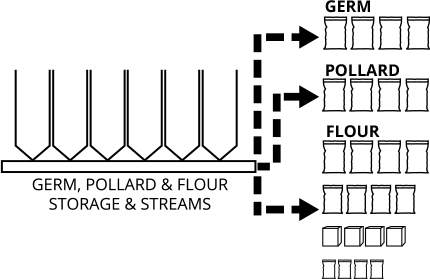
After “enough” Grinding and Sifting, multiple streams of the various components of the grain are created. Selected streams of like product are combined, such that individual streams of Semolina, and Flour, and Germ, and Bran, and Pollard can all flow out of the Mill and be stored and then packed in to suitable containers for provision to customers.